Two Major Technologies for Growing Gallium Arsenide Crystals: LEC vs. VGF
In the world of semiconductor crystal growth, LEC and VGF are two of the most common process names you'll hear. They represent two different technical paths, each with its own unique principles, strengths, and ideal applications. For non-experts, these abbreviations might sound like jargon. But once you understand how they work, it becomes clear why today's smartphones, 5G base stations, and lasers perform so incredibly well.
LEC Method: Liquid Encapsulated Czochralski
LEC stands for "Liquid Encapsulated Czochralski." The name breaks down into three key parts: Liquid, Encapsulated, and Czochralski (a pulling method).
How It Works
Think about making cotton candy: sugar syrup melts in a container, a stick dips in and slowly pulls up, and the syrup sticks to the stick, solidifying into fluffy cotton candy. The LEC method works on a similar principle, but it's way more complex and precise.
Inside a high-pressure furnace, polycrystalline gallium arsenide (GaAs) is placed in a PBN crucible and heated until it melts. The surface of this molten material is covered with a special substance—boron oxide (B₂O₃). At high temperatures, this boron oxide becomes a molten "liquid lid" that sits on top of the GaAs melt, sealing it. That's where the "Liquid Encapsulation" part comes from.
Fig 1. Schematic diagram of liquid encapsulated Czochralski method.
Why is this seal needed? Because arsenic in the GaAs melt tends to evaporate easily at high temperatures. Without this "liquid lid," the arsenic would constantly escape, throwing off the melt's composition. The boron oxide layer effectively stops this evaporation and also prevents impurities from the furnace atmosphere from contaminating the melt.
The furnace is also filled with high-pressure inert gas (usually argon) at 2-6 megapascals. This adds another layer of protection against arsenic evaporation—think of it as a double safety measure.
Here's the critical step: A pulling rod with a small seed crystal (a tiny piece of single-crystal GaAs) lowers from the top until it touches the melt. The seed melts just a little bit, and then the rod slowly starts pulling upwards and rotating. By precisely controlling the temperature and pull speed, the melt solidifies onto the seed crystal, copying its crystalline structure and gradually forming a complete, cylindrical single crystal.
Key Features and Advantages of LEC
LEC's biggest advantage is its ability to grow large-diameter round crystals. Because the crystal rotates freely during growth, its diameter can be accurately controlled by adjusting the pull speed and temperature. Right now, LEC can reliably produce 6-inch (150mm) and even 8-inch (200mm) GaAs crystals.
Plus, crystals grown with LEC are perfectly cylindrical. This means they can be directly sliced into round wafers, which is efficient for material use and makes the follow-up processing simpler.
LEC is mainly used for growing semi-insulating GaAs crystals. These materials need to be extremely pure, and the LEC process, with its controlled environment, can meet the tough requirements for things like RF devices and optoelectronic integrated circuits.
Limitations of LEC
But LEC has its downsides. Because the area above the melt is a hot gas environment, the crystal goes through a steep temperature gradient as it's pulled (up to 100-150 K/cm). This creates significant thermal stress inside the crystal, leading to a higher density of dislocations—defects in the crystal's atomic structure (typically over 10⁴ per square centimeter). These dislocations can affect how well a device performs and how long it lasts.
Another issue is keeping the chemical composition just right. Even with the encapsulation and high pressure, arsenic can still evaporate, making it tough to precisely maintain the balance between arsenic and gallium in the melt, which might mess with the crystal's electrical properties.
But there's a lot of research going on right now to overcome these limitations.[i]
VGF Method: Vertical Gradient Freeze
VGF stands for "Vertical Gradient Freeze." Unlike LEC's "dynamic growth," VGF uses a "static growth" approach.
How It Works
Imagine a vertically placed cylindrical furnace. Inside, a PBN crucible holds polycrystalline GaAs, with a small seed crystal at the bottom. The whole crucible setup is sealed inside an evacuated quartz tube and fixed vertically in the furnace.
The furnace has multiple independently controlled heating zones, allowing for super precise temperature adjustments at different heights. To start, the top part of the polycrystalline material is heated until it melts completely, while the bottom region with the seed is kept just below the melting point. This melts part of the seed but leaves a small solid portion as the "seed" for growth.
Now for the key part: A computer program slowly reduces the power to the heaters, causing the temperature gradient in the furnace to move gradually from the bottom up. As the temperature drops, the solid-liquid interface starts at the seed and moves upward at a very slow pace. The melt solidifies at this interface, copying the seed's crystal structure, until eventually, the entire melt in the crucible becomes one complete single crystal.
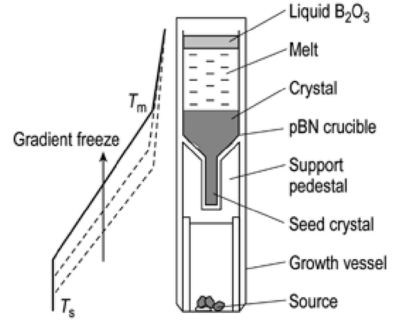
Fig 2. Vertical gradient freeze of semiconductor compounds (GaAs, InP) with stoichiometry control by means of a source of the volatile element (As, P) at T s
Throughout the whole process, the crucible and furnace stay completely still—no mechanical movement at all. It's all about precisely controlling the temperature field to drive crystal growth.
Key Features and Advantages of VGF
VGF's biggest strength is its ability to grow super high-quality crystals with extremely low dislocation densities. Because the temperature gradient is tiny (usually only 5-10 K/cm), the growth process is very gentle, creating minimal thermal stress. This means dislocation densities can be kept very low.
Recent studies show that 8-inch silicon-doped GaAs crystals grown with VGF have an average dislocation density below 30 per square centimeter! In fact, 98.87% of the wafer area can be completely dislocation-free. That's near-perfect crystal quality that LEC just can't match.
Another plus is precise control over the chemical composition. Since the crucible is sealed inside a quartz tube, arsenic evaporation is effectively stopped, keeping the melt stable.
VGF can be used for both low-resistivity and semi-insulating GaAs crystals. Its range of applications is even broader than LEC's.
Limitations of VGF
The main drawback of VGF is the long growth cycle. With such a small temperature gradient, the crystal has to grow very slowly, often taking days or even weeks to finish one run. LEC, on the other hand, only takes tens of hours.
Also, VGF requires incredibly precise temperature control, making the heating system design and control algorithms more complex. The crystal's shape is also limited by the crucible's shape. While you can design crucibles to get near-round crystals, the diameter uniformity isn't as good as with LEC-grown crystals.
LEC vs. VGF: A Comparison
To see the differences more clearly, here's a breakdown:
|
Comparison Aspect |
LEC Method |
VGF Method |
|
Growth Principle |
Crystal pulling, dynamic growth |
Moving temperature gradient, static solidification |
|
Temperature Gradient |
Large (100-150 K/cm) |
Small (5-10 K/cm) |
|
Growth Speed |
Fast (tens of hours per run) |
Slow (days to weeks per run) |
|
Crystal Diameter |
Large (up to 8 inches) |
Large (up to 8 inches) |
|
Crystal Shape |
Standard cylindrical |
Influenced by crucible shape |
|
Dislocation Density |
Higher (in the range of 10⁴/cm²) |
Extremely low (can be below 30/cm²) |
|
Main Applications |
Semi-insulating substrates |
Low-resistivity and semi-insulating substrates |
Choosing the Right Method in Practice
In actual production, choosing LEC or VGF really depends on what you need for the final product.
For RF microelectronics, like power amplifiers in smartphones or RF chips in base stations, you need semi-insulating GaAs substrates. These applications demand extremely high purity but are more forgiving about dislocation density. LEC, with its large diameter, high efficiency, and good purity control, is the go-to choice here.
For optoelectronic devices, such as LEDs and lasers, you need low-resistivity GaAs substrates, and crystal quality is super important. The low-dislocation crystals from VGF can significantly boost how efficiently these devices emit light and how long they last.
For high-performance RF devices that require both semi-insulating properties and high crystal quality, VGF is increasingly becoming the preferred method. This trend is even stronger as 8-inch VGF technology matures.
Conclusion
LEC and VGF represent two different philosophies. One goes for efficiency and large size, using active control for fast growth. The other focuses on quality and perfection, using precise temperature control to get near-ideal crystal structure. Neither is absolutely better or worse—it's all about finding the right fit for what you're trying to build.
Stanford Electronics offers GaAs wafers produced by two main growth techniques. This allows us to provide customers with the widest choice of GaAs material.